Koox · A scroll documentary

Unreached

A true story told with real records, satellite images and labelled reconstructions.

Scroll to move through the story. Reconstructed scenes are marked as such.
Koox · Unreached
Scroll
Reconstruction
There is an island in the Bay of Bengal where the people have turned away every outsider who has ever come. Ships. Soldiers. Scientists. Film crews. A missionary. For as long as anyone has kept records, the answer has been the same.

Unreached

The island that has said no for 250 years

Scroll
India
Myanmar
Thailand
Sri Lanka
Bay of Bengal
Andaman Sea
Andaman Islands
Port Blair
≈ 50 km
North Sentinel
Evidence · satellite imagery

North Sentinel Island

Andaman Islands, India · about 50 km west of Port Blair

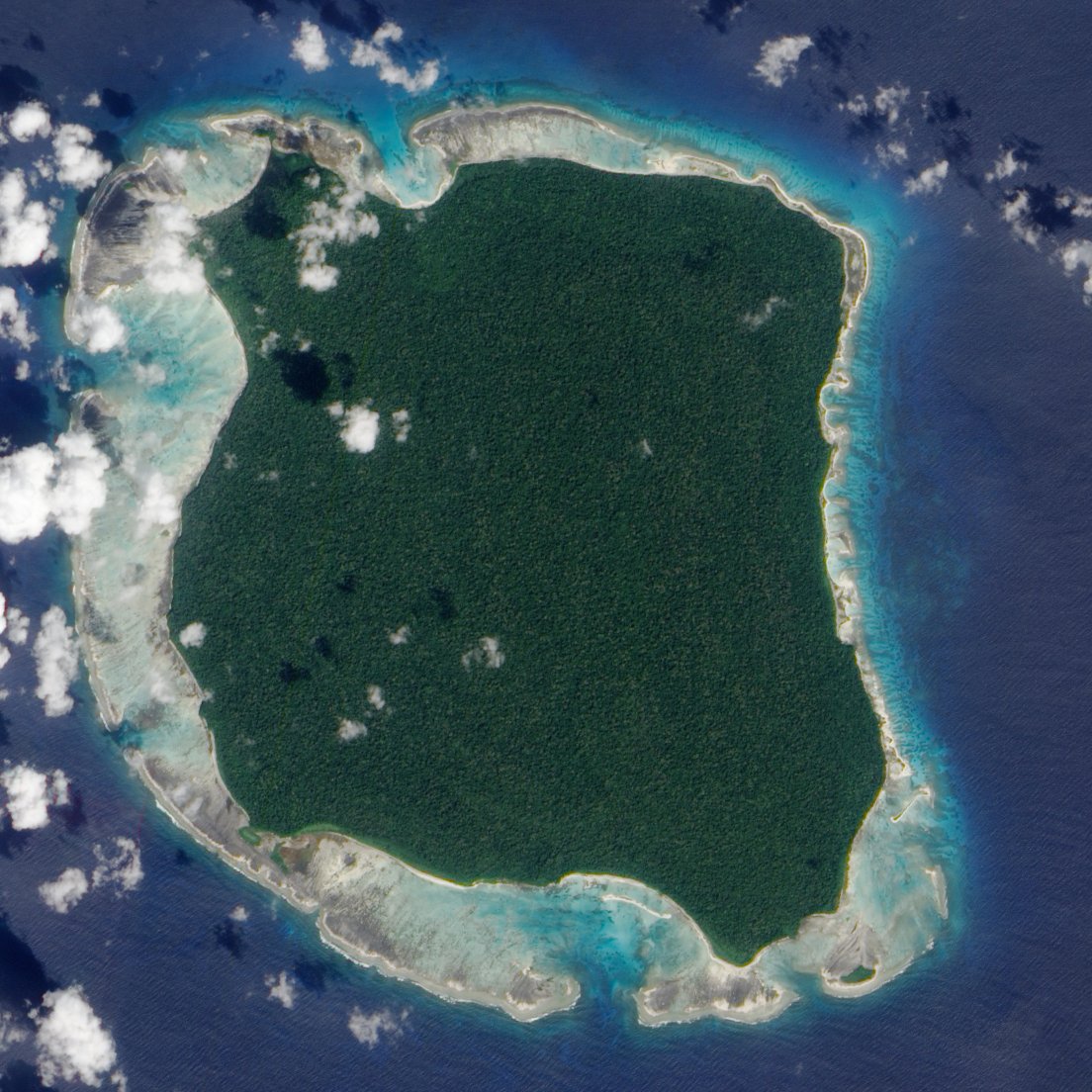
It lies about fifty kilometres west of Port Blair, the capital of India's Andaman Islands. It is small: about sixty square kilometres of forest, ringed by coral reef.
Imagery: NASA Blue Marble · Sentinel-2 cloudless 2016 by EOX IT Services, contains modified Copernicus Sentinel data, CC BY 4.0 · NASA Earth Observatory, EO-1 ALI, 20 Nov 2009 · Coastline © OpenStreetMap contributors
Reconstruction
Dense forest to the shore.
Reef all around.
No harbour. No landing place.
No one has ever mapped its interior. No outsider has ever lived there. Everything we know about it has been seen from a boat, a helicopter, or from space.
Reconstruction · based on published photographs and accounts
Unknown. Estimates range from about 15 to a few hundred.
Unknown to outsiders.
Unknown.
They hunt and gather, and fish the lagoons from narrow canoes pushed with poles.
Taken from shipwrecks on their reef, and shaped into arrowheads.
We call them the Sentinelese. We don't know what they call themselves. We don't know their language, or how many of them there are. We know they hunt in the forest and fish the shallows. And that the iron for their arrows comes from the ships that have broken on their reef.
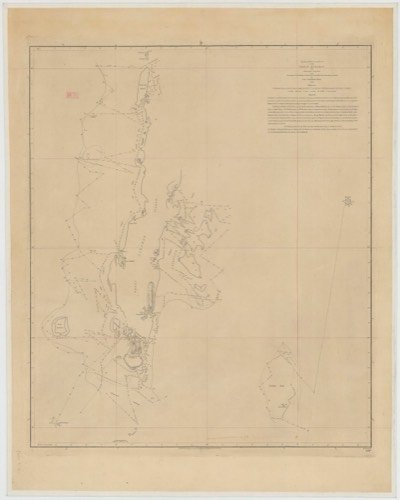
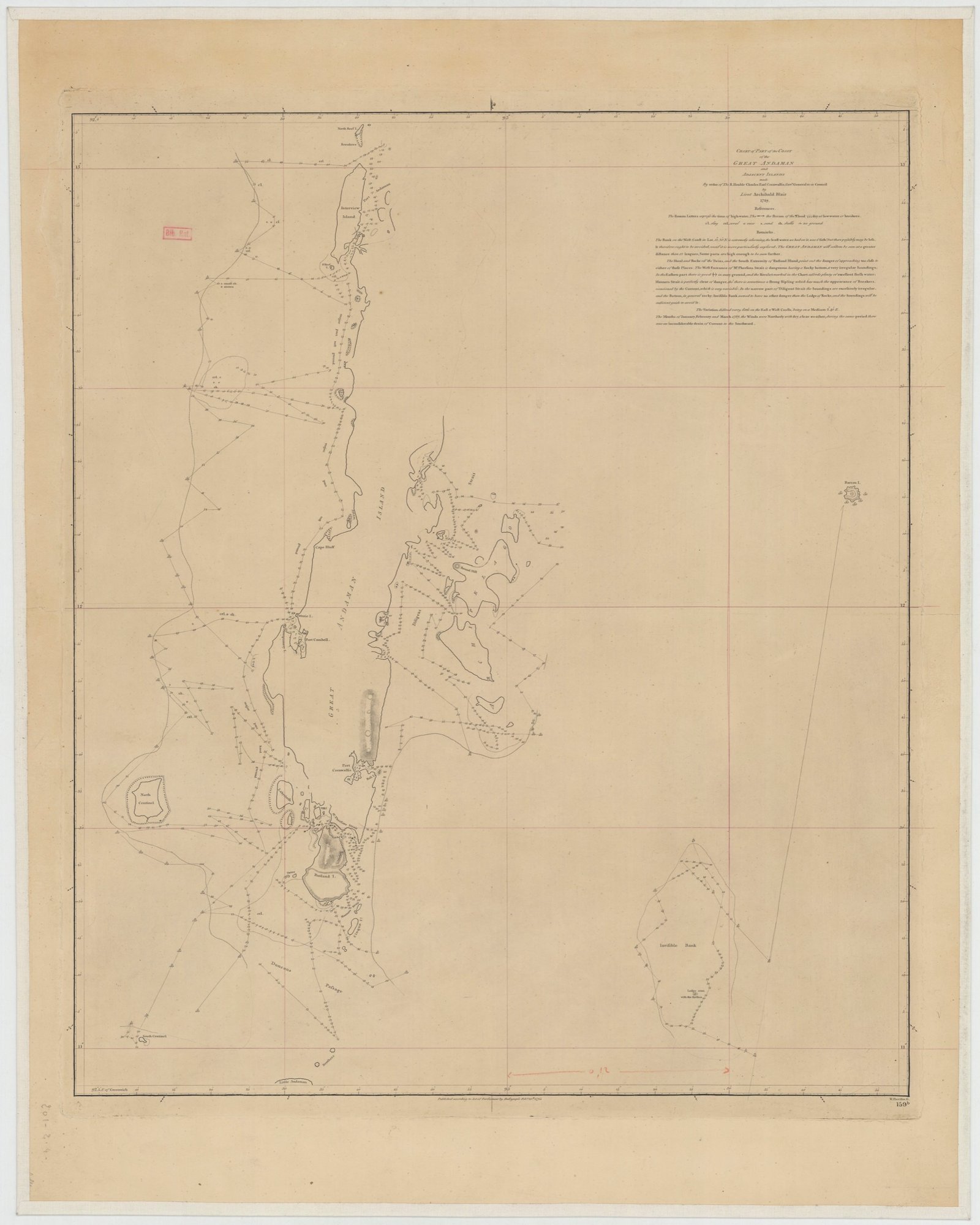
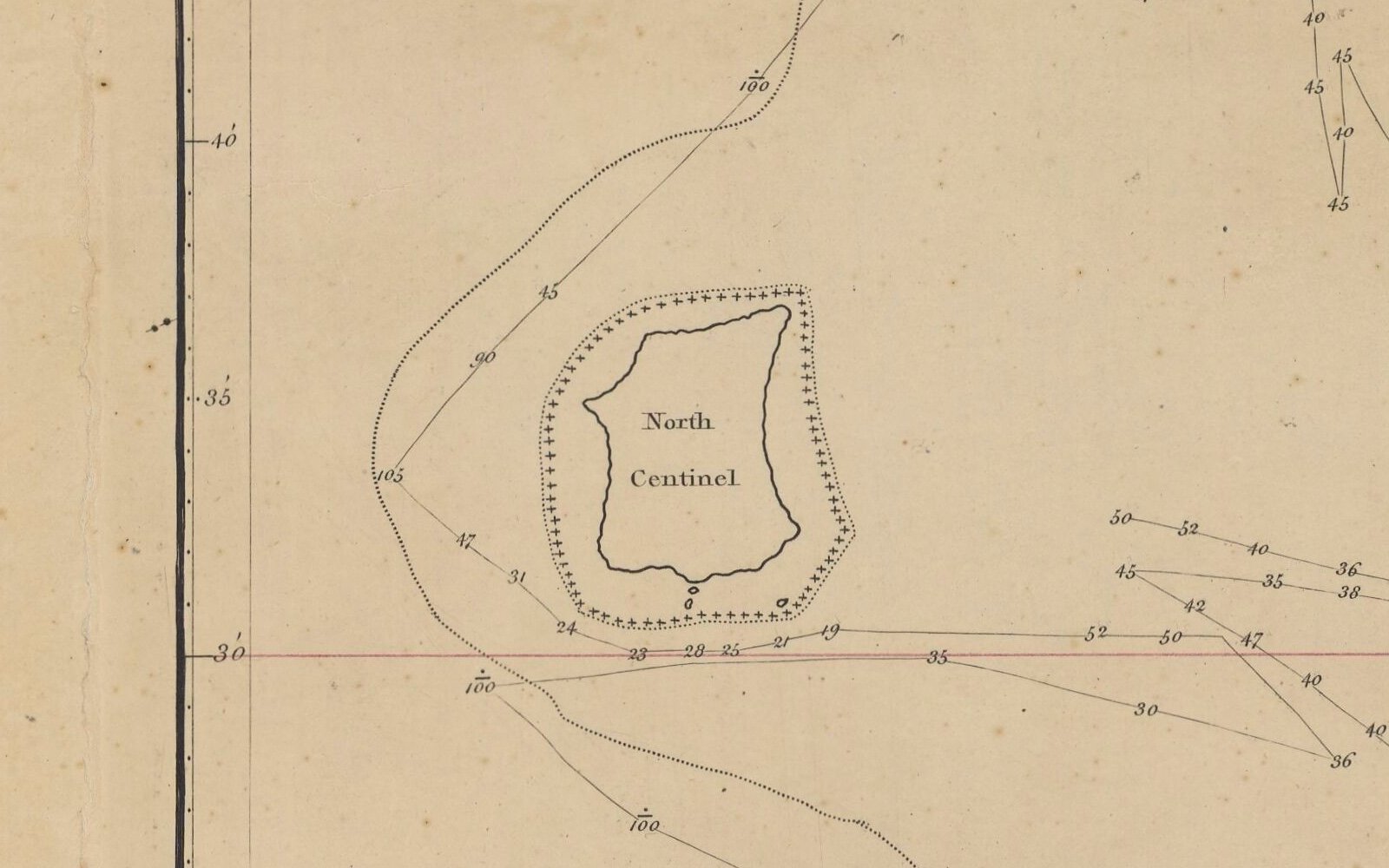
Chart of part of the coast of the Great Andaman and adjacent islands, by Lt. Archibald Blair, 1789
Archive · chart of the Andaman Islands, 1789
Reconstruction
1771A British survey ship passes the island at night
Chart by Lt. Archibald Blair, surveyed 1789. The island is marked "North Centinel". Bibliothèque nationale de France, via Wikimedia Commons, public domain
The first written record is a single line. In 1771, a surveyor aboard the East India Company ship Diligent looked across at the island in the dark, and noted "a multitude of lights". The ship sailed on. No one went ashore.
17711867188018961967197419811991200420062018
Reconstruction
1867The merchant ship Nineveh is wrecked on the reef. 106 people reach the shore.
In 1867, the Indian merchant ship Nineveh ran onto the reef in a storm. All one hundred and six people aboard reached the beach. On the third day, the islanders came out of the forest, with iron-tipped arrows. The survivors fought them off with sticks and stones, until a Royal Navy party arrived to take them away.
17711867188018961967197419811991200420062018
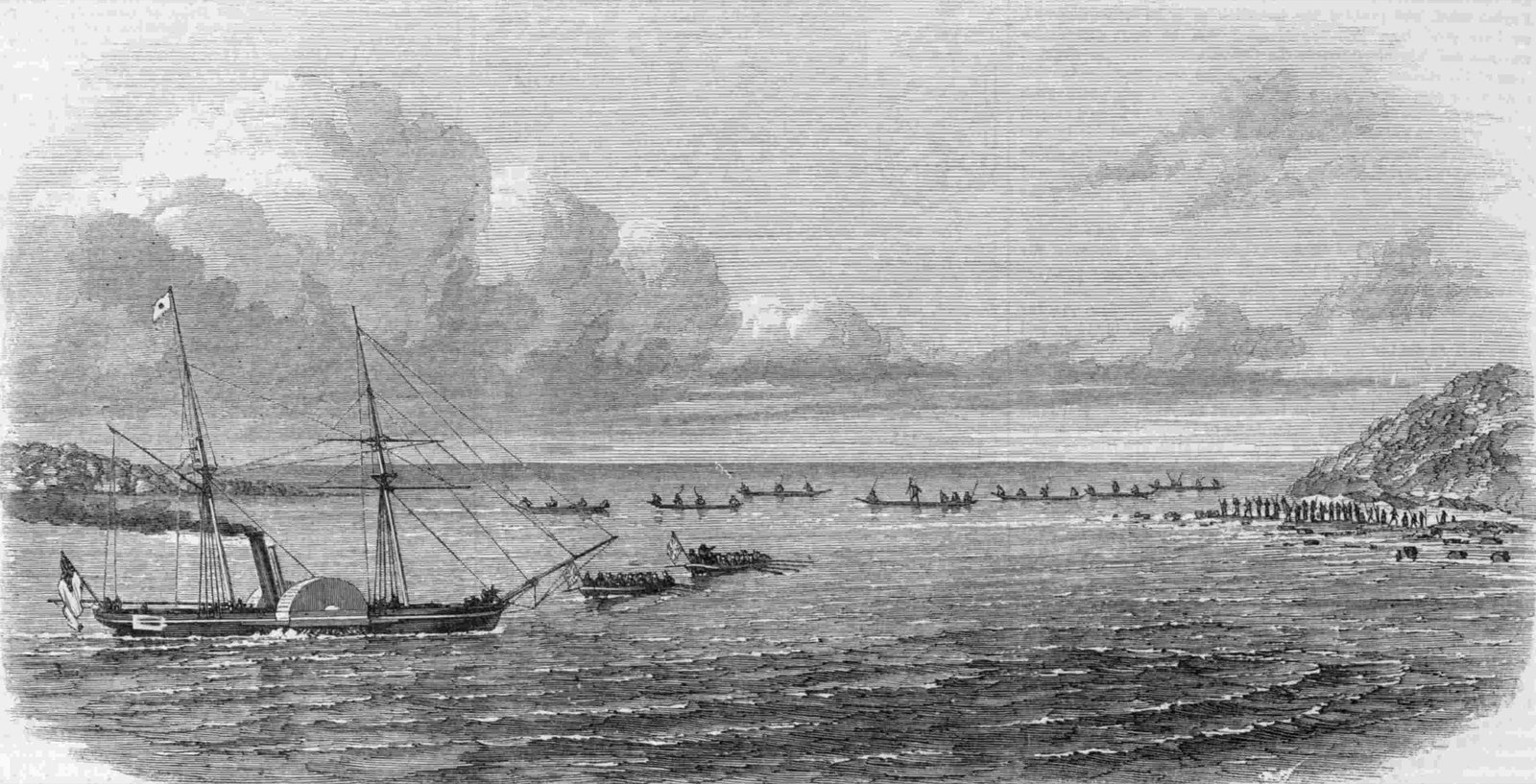
Engraving: boats of the steamer Pluto approach Andaman Islanders on a beach, 1858
Illustrated London News, 27 March 1858 · Boats of the steamer Pluto approach the Andaman Islanders
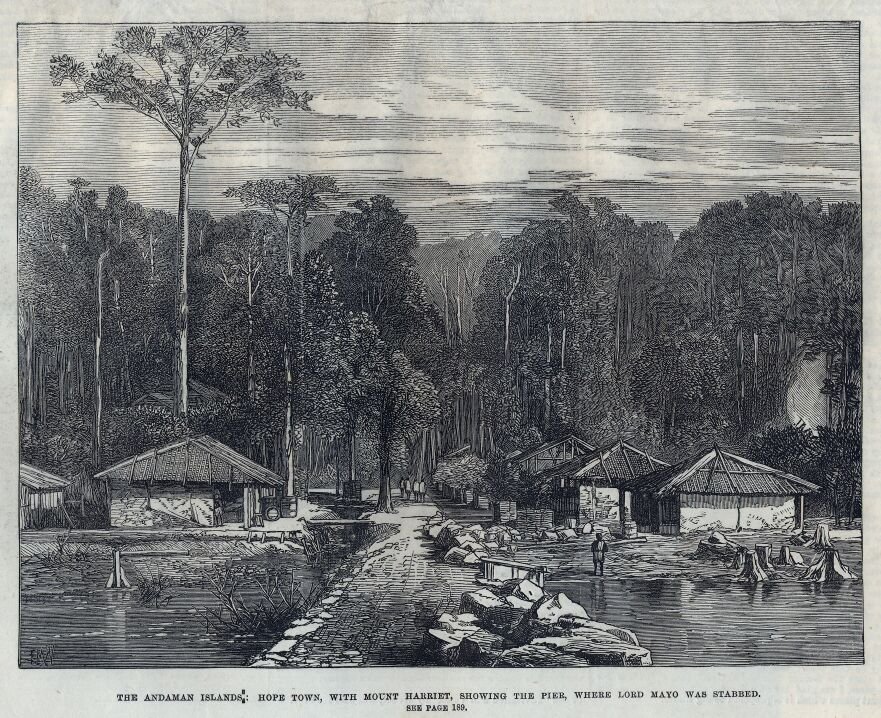
Engraving: Hope Town, Port Blair penal settlement, with huts, a pier and cleared forest, 1872
Illustrated London News, 24 February 1872 · Hope Town, in the Port Blair penal settlement
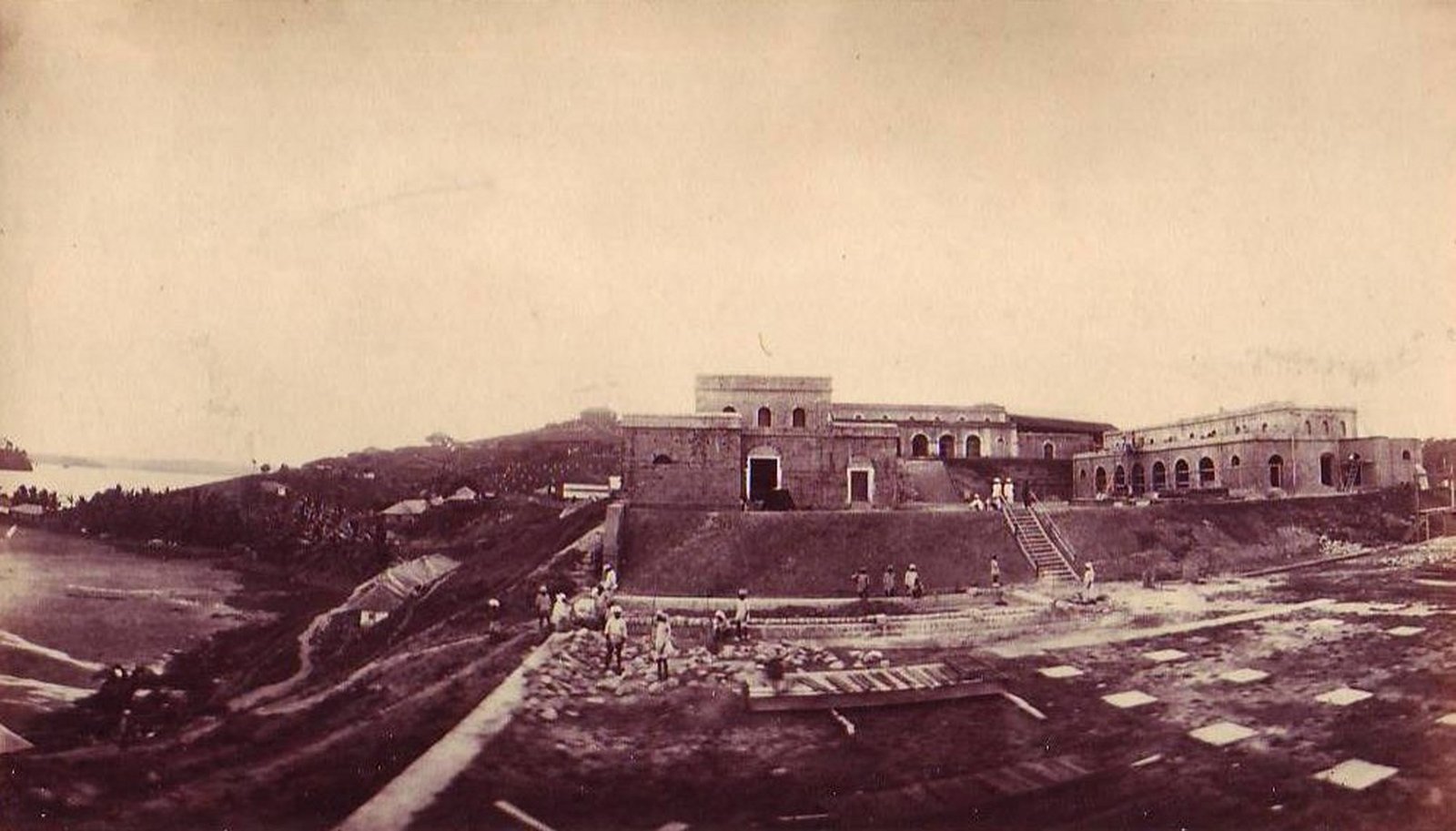
Photograph: a stone jail under construction at Port Blair, with workers on the site
Photograph, undated, photographer unknown · "Port Blair, panoramic view of Viper new jails"
Archive · public domain
1858Britain founds a penal colony at Port Blair
To understand why the island says no, look at its neighbours. In 1858, Britain founded a penal colony at Port Blair, and the outside world arrived in the Andaman Islands to stay.
177118581867188018961967197419811991200420062018
5,000Great Andamanese · each dot ≈ one person
Evidence · population records
5,000 → a few dozenThe Great Andamanese, from the founding of the colony to the 20th century
about 5,0001858 6251901 census a few dozena century on
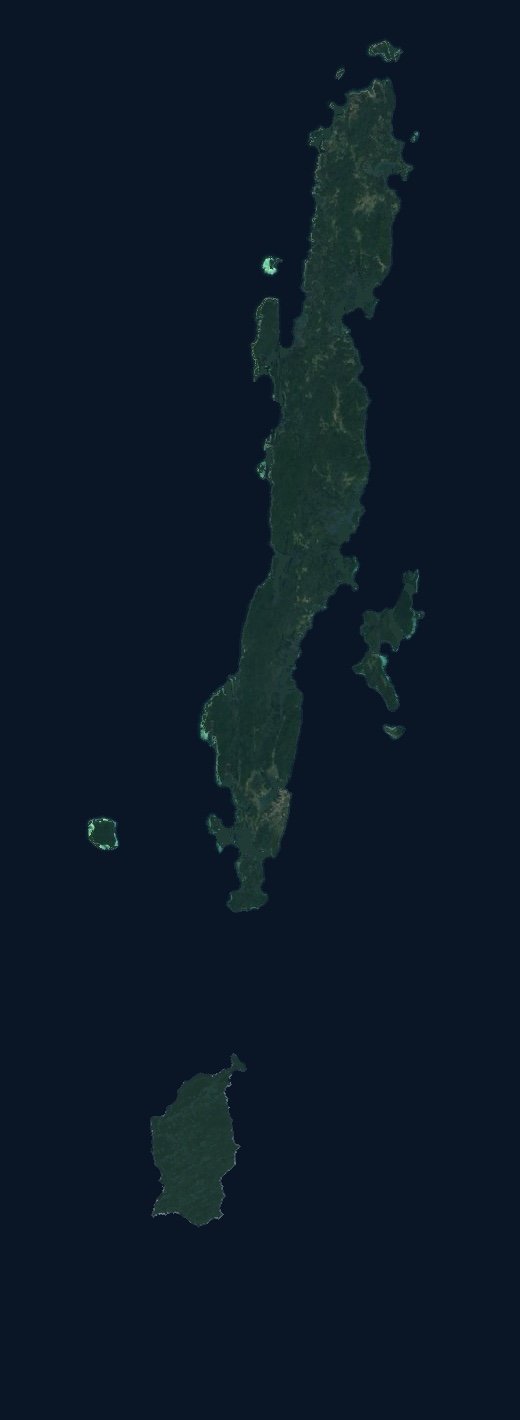
Satellite map of the Andaman Islands
Great Andamanesemain islands · now a few dozen
Jarawawest coast forests
OngeLittle Andaman
SentineleseNorth Sentinel
Figures: about 4,800 in 1858 (Cultural Survival) · 625 in the 1901 census · "36 from 5,000 a century ago" (Minority Rights Group, 2008). The line joins the recorded figures.
Map: Sentinel-2 cloudless 2016 by EOX IT Services, contains modified Copernicus Sentinel data, CC BY 4.0. Sea and cloud cleaned for legibility
The Great Andamanese, the people of the main islands, numbered about five thousand. Measles, pneumonia and other diseases they had never met swept through them. Within a century, only a few dozen were left. The Sentinelese were spared, perhaps because they kept everyone away.
177118581867188018961967197419811991200420062018
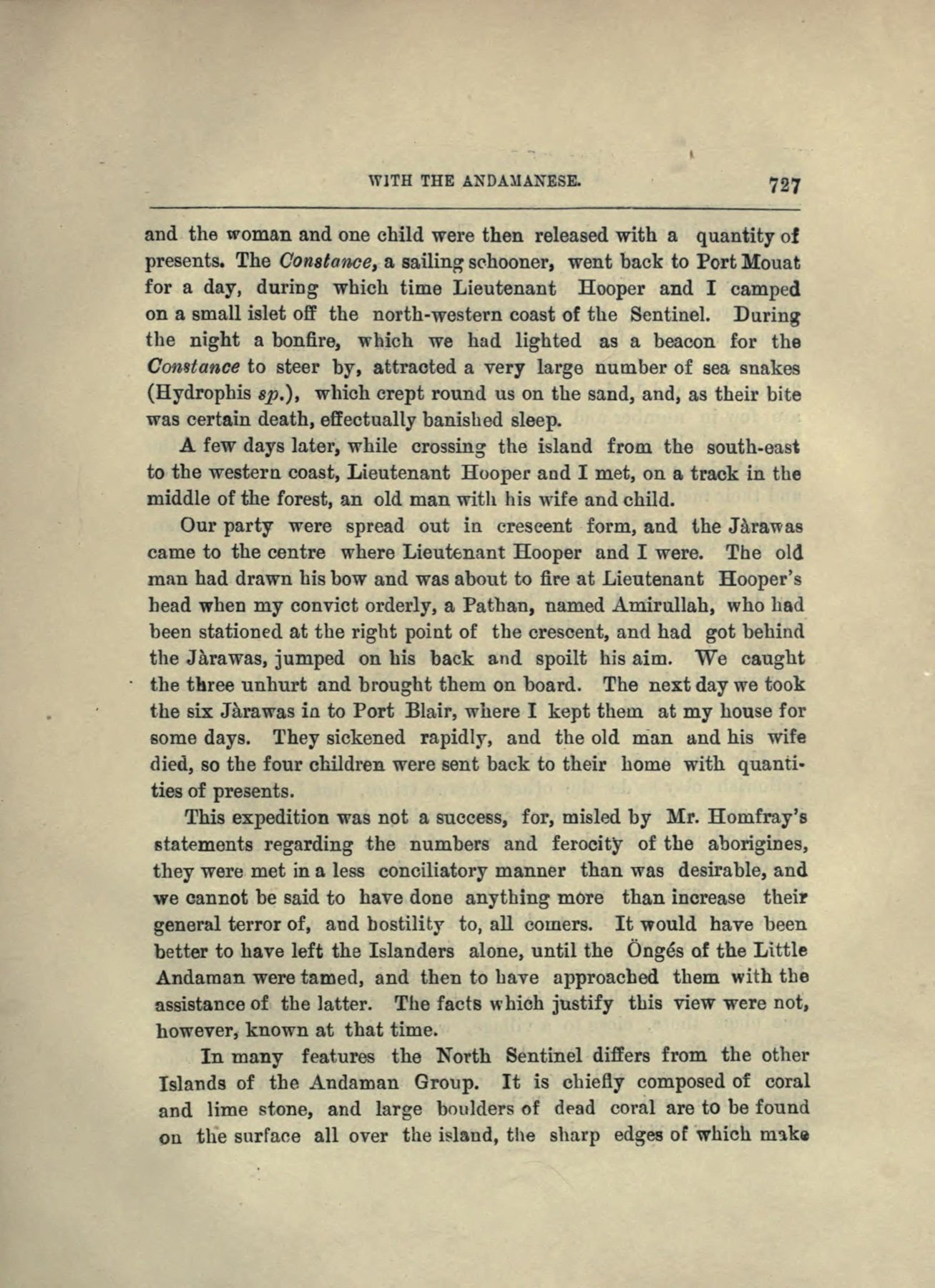
Printed page 727 of M. V. Portman, A History of Our Relations with the Andamanese, 1899
M. V. Portman, A History of Our Relations with the Andamanese, vol. II, p. 727 (1899). He calls the islanders "Jàrawas"
Reconstruction
Archive · Portman, 1899 · public domain
1880A British expedition lands, led by the officer Maurice Vidal Portman
In 1880, a British officer named Maurice Vidal Portman landed with an armed party. They found paths and empty villages. The islanders had fled. After several days, they took six people: an elderly couple, and four children. In Port Blair, all six fell ill. The old man and woman died. The four children were taken back to the island, with gifts, and left on the beach. Portman later wrote that they had done little more than increase the islanders' "terror of, and hostility to, all comers".
17711867188018961967197419811991200420062018
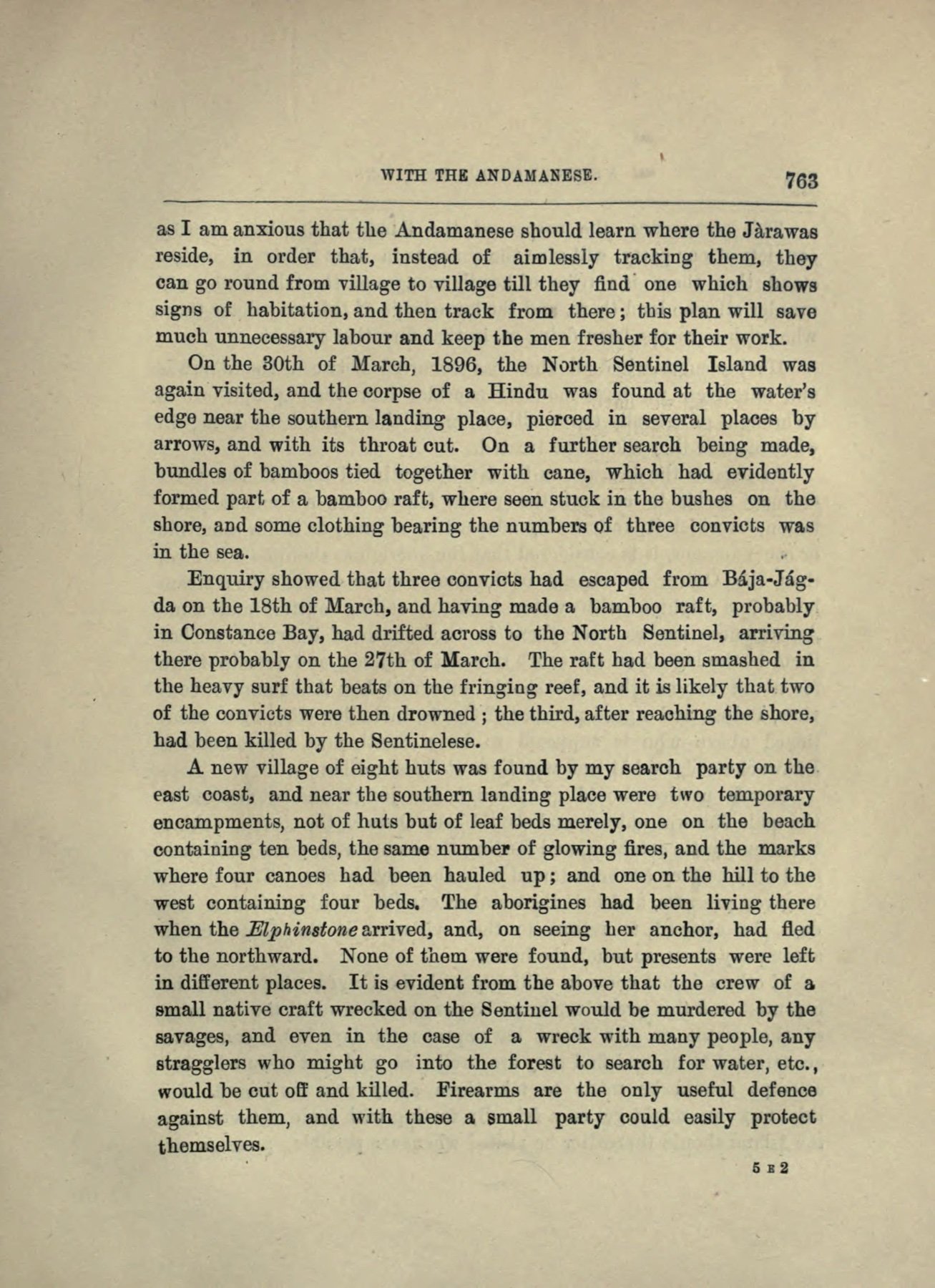
Printed page 763 of M. V. Portman, A History of Our Relations with the Andamanese, 1899
M. V. Portman, A History of Our Relations with the Andamanese, vol. II, p. 763 (1899): the report of his own search party, 30 March 1896
Reconstruction
Archive · Portman, 1899 · public domain
1896Three prisoners escape the penal colony on a raft
In 1896, three prisoners escaped the penal colony on a bamboo raft. The current carried them to North Sentinel. The raft broke apart on the reef. Two of the men probably drowned. The third reached the shore. A search party found his body at the water's edge, days later.
17711867188018961967197419811991200420062018
Reconstruction
1967India's Anthropological Survey begins "contact expeditions", led by T. N. Pandit
After independence, India tried a gentler way. From 1967, government teams led by the anthropologist T. N. Pandit sailed out with gifts: coconuts, bananas, cloth, metal pots. They left them on the shore and waited. Sometimes the gifts were taken. Often, arrows were the reply.
17711867188018961967197419811991200420062018
Reconstruction
1974A National Geographic documentary crew arrives to film
In 1974, a film crew came to make a documentary called Man in Search of Man. They left gifts on the sand, among them a toy car, a doll and cooking pots. The answer was a volley of arrows. One struck the director in the thigh. Later, the islanders speared the doll, and buried it.
17711867188018961967197419811991200420062018
Satellite image of North Sentinel Island and its reef
Cannibals beseige shipHeadline, The Press (Christchurch), 19 August 1981 · via Papers Past · spelling as printed
Evidence · NASA Earth Observatory, EO-1, 2009
Reconstruction
Archive · press, 1981
The wreck lies on the reef off the north shore
1981The cargo ship Primrose runs aground. Its wreck is still on the reef.
In August 1981, the cargo ship Primrose ran aground on the reef in heavy seas. Its captain radioed an urgent message: more than fifty armed men were building boats on the beach. He asked for firearms to be dropped. For a week, the crew kept watch day and night, with axes and flare guns, until a helicopter lifted all of them to safety. The newspapers called the islanders cannibals. The wreck is still there.
17711867188018961967197419811991200420062018
0years since the first written record, 1771
4 January 1991
For the first time, the islanders come out to meet them without weapons
In the boat

Madhumala

Chattopadhyay

Anthropologist. The first woman to meet the Sentinelese.

Reconstruction
Then, in January 1991, something changed. As T. N. Pandit's team floated coconuts toward the shore, the islanders walked into the water without their weapons, and took them. A young anthropologist, Madhumala Chattopadhyay, was in the boat: the first woman to meet the Sentinelese. When a young man raised his bow, a woman beside him pushed it down. On a second visit, weeks later, the islanders came out unarmed again, and even climbed into the boats to collect the coconuts.
17711867188018961967197419811991200420062018
Reason 01

Disease

Reason 02

Dependence

Reason 03

They never asked

Invitation from the island:
Government gift visits
Began1967Endedlate 1990s
The law that protects them

Andaman and Nicobar Islands (Protection of Aboriginal Tribes) Regulation, 1956

In force since 1956. Entering a tribal reserve without permission is an offence.

Satellite image of North Sentinel Island
No-approach zonePatrolled · never landing
Evidence · policy
Reconstruction
The 1990sIndia ends the gift visits. The new rule: leave them alone.
It might have been the beginning of friendship. Instead, India chose to stop. Contact had brought disease to every other people in these islands. Gifts could create dependence. And the islanders had never once asked anyone to come. By the late 1990s, the visits ended. The policy since has been to protect them from a distance: to watch, and never to land.
17711867188018961967197419811991200420062018
0.0Magnitude · Sumatra–Andaman earthquake
26 December 2004
An earthquake and tsunami strike the Indian Ocean
Reef exposed
Sea level · unchanged
+0.0 mUplift of the island · 2004
3D reconstruction from NASA EO-1 imagery · vertical scale exaggerated
Evidence · uplift, 2004
Reconstruction
On the twenty-sixth of December, 2004, one of the largest earthquakes ever recorded struck the Indian Ocean. Here, the quake lifted the whole island by more than a metre and a half. The reef rose out of the sea. Three days later, a government helicopter flew over to look for survivors. The islanders came out onto the reef, and shot arrows at it. They had survived. And they still didn't want visitors.
17711867188018961967197419811991200420062018
Anchored off the reef · fishing illegally
Drifted ashore
Reconstruction · illustrative drift · coastline © OpenStreetMap contributors

No one was charged.

The law that protects the island does not reach its people.

Andaman and Nicobar Islands (Protection of Aboriginal Tribes) Regulation, 1956
Reconstruction
January 2006Two fishermen, Sunder Raj and Pandit Tiwari, are fishing illegally near the island
In 2006, two fishermen, Sunder Raj and Pandit Tiwari, were fishing illegally near the island. While they slept, their boat drifted onto the shore. They were killed. A Coast Guard helicopter later saw their bodies buried in the sand. When it flew low, it was met with arrows.
17711867188018961967197419811991200420062018
First attemptAn arrow strikes his Bible · he turns back
He went backAlone, by kayak
Days laterSeen from the fishermen's boat
7
people who helped him were arrested
His bodyNever recovered
RecoveryJudged too dangerous for both sides
Reconstruction
November 2018A 26-year-old American missionary pays fishermen to take him to the island
In November 2018, John Allen Chau, a twenty-six-year-old American missionary, paid local fishermen to take him to the island, knowing it was illegal. On his first attempt, a boy shot an arrow at him. It struck the waterproof Bible he was holding against his chest. He went back anyway. Days later, the fishermen saw islanders dragging his body along the beach. His body was never recovered. The police decided that trying would put both sides in danger.
17711867188018961967197419811991200420062018
Protected under the 1956 RegulationEntering without permission is an offence
Patrolled by the navyIllustrative route
One visitorcarrying a common cold
No immunity to itIllustration, not data
What contact cost their neighbours about 5,000 · 1858625 · 1901a few dozen · 2008
5,000 → a few dozenThe Great Andamanese. Cultural Survival; 1901 census; Minority Rights Group, 2008
1771
Images: reconstructions from earlier chapters

Eyes on, hands off

India's policy on the Sentinelese

Entering without permission is an offence1956 Regulation
The navy patrols the watersPress reports, 2018
Outsiders' diseases could devastate themSurvival International
Reconstruction
TodayApproaching North Sentinel Island is illegal
Today it is illegal to approach the island, and the navy patrols the waters around it. The danger runs both ways. A common cold could kill people who have never met it. We have already seen what contact did to their neighbours. And above all, they have told us, again and again, for two hundred and fifty years, what they want.
17711867188018961967197419811991200420062018
North Sentinel

Unreached

Reconstructions

AI-generated imagery made with Seedream 5 Pro and Seedance 2.5, via OpenArt. Every reconstructed shot is labelled.

Archive

Lt. Archibald Blair's chart, 1789 (BnF) · Illustrated London News, 1858 and 1872 · "Viper new jails" photograph · M. V. Portman, 1899 · all public domain · press headline, 1981

Satellite and maps

NASA Blue Marble · NASA Earth Observatory, EO-1 ALI, 2009 · Sentinel-2 cloudless 2016 by EOX IT Services, contains modified Copernicus Sentinel data, CC BY 4.0 · OpenStreetMap contributors · USGS

Records

Survival International · Minority Rights Group · Cultural Survival · the 1956 Regulation · census records · contemporary press, 1981 to 2018

How this was made. Most of these moments were never filmed, and no outsider may approach the island today, so they are reconstructed from published accounts. Reconstructions show how events could have looked, not how they did. Real archival images are shown unaltered. The Sentinelese did not take part in, or consent to, this film.

Koox · a scroll documentary · score and narration made with Suno
Imagery: NASA Blue Marble · Sentinel-2 cloudless 2016 by EOX IT Services, contains modified Copernicus Sentinel data, CC BY 4.0 · NASA Earth Observatory, EO-1 ALI, 20 Nov 2009
Reconstruction
There are almost no places left on Earth that we haven't reached. This is one of them, not because we couldn't, but because they said no. Perhaps the most respectful thing we can do, is listen.
17711867188018961967197419811991200420062018